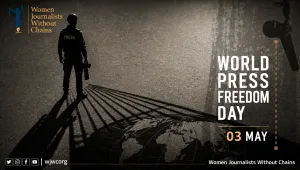
Press freedom in Yemen and across the Middle East and North Africa has deteriorated sharply over the past year, with journalists increasingly exposed to abuses that in some conflict zones amount to war crimes, the advocacy group Women Journalists Without Chains (WJWC) said in a statement marking World Press Freedom Day on May 3.
The
organization
described a “systematic and dangerous decline” in protections for journalists between May 2025 and May 2026, citing a surge in arbitrary arrests, extrajudicial killings and the use of domestic laws to silence independent voices. It warned that the erosion of international safeguards has left reporters operating in increasingly hostile and lawless environments.
Yemen remains a focal point of concern, the group said. Thirty-one media workers were killed in September 2025 in an Israeli strike on a Houthi-affiliated media center, while local actors have continued to carry out arbitrary detentions and unfair trials. The country’s protracted conflict, now in its second decade, has further compounded risks for journalists attempting to report from the ground.
Tawakkol Karman, chair of WJWC and a Nobel Peace Prize laureate, said the current trajectory signals what she described as “the official death of international immunity for journalists,” arguing that reporters in the region are no longer facing only the traditional hazards of the profession but are increasingly subjected to targeted killings and systematic repression.
“The international community’s failure to protect hundreds of journalists in Gaza, Sudan and Yemen — and its silence toward the weaponization of laws against free expression in several countries — amounts to a green light for the continuation of these crimes,” Karman said, urging governments and international bodies to move beyond statements of condemnation and take concrete steps to hold perpetrators accountable.
The report highlighted the particular vulnerability of women journalists, who face overlapping forms of abuse, including political repression and gender-based violence, in what it described as a climate of near-total impunity involving both state and non-state actors.
Across the region, the group documented at least 207 media workers killed in Gaza since October 2023, along with the detention of 94 journalists. In Sudan, 16 journalists were killed amid allegations that starvation and sexual violence were used as tools of war. Somalia recorded 72 violations, largely attributed to security forces, while Syria saw limited improvement despite ongoing instability.
In the Gulf, the organization said media environments remain tightly controlled by governments, with continued persecution of dissenting voices. It cited the 2025 execution of Saudi journalist Turki al-Jasser and pointed to what it described as an escalation in security crackdowns in the United Arab Emirates in 2026, including the use of misinformation laws to target bloggers. Similar punitive practices, including the revocation of citizenship, were reported in Kuwait and Oman.
Iran, the report said, has intensified its domestic crackdown on journalists amid regional tensions, with hundreds detained, including many women, and independent media outlets dismantled. Elsewhere, countries such as Egypt, Tunisia and Jordan have continued to rely on broad legal frameworks to restrict press freedoms and prosecute journalists.
WJWC said the documented abuses constitute clear violations of international law, including the International Covenant on Civil and Political Rights, and in some cases may amount to war crimes requiring the application of universal jurisdiction.
The organization called for the immediate and unconditional release of all journalists detained for their work, reforms to repeal or amend restrictive laws — particularly those related to cybercrime and nationality — and stronger international mechanisms to investigate crimes against journalists.
It also urged the U.N. Human Rights Council to establish independent investigative bodies and called for greater protections for women journalists, as well as a halt to the export of surveillance technologies used by governments to monitor and suppress media workers.
Without meaningful accountability, the group warned, the region is likely to see a continued erosion of press freedom, with Yemen among the most affected countries.
 تابعوا آخر أخبارنا المحلية وآخر المستجدات السياسية والإقتصادية عبر Google news